"...The Gospels, revealingly, tell us little of Jesus' spiritual formation and concentrate mostly on his words and actions. The Buddha story, by comparison, places most of its emphasis on how Siddhartha came to enlightenment - the process (which anyone can follow, even today, in principle) - while the particular details of his subsequent teachings and wanderings are often barely mentioned.
Even non-Christians may know some of Jesus' words, while typical Buddhists may know hardly any of Buddha's specific discourses. Buddha is a precedent more than a prophet; and where Jesus came to earth as the way, the truth, and the life, the Buddha came to suggest that the way is up to us, the 'truth' is often impermanent, and the light comes and goes, comes and goes, until we have found something changeless within."
Page 90.
'The Open Road - The Global Journey of the Fourteenth Dalai Lama'
Pico Iyer
Monday, August 30, 2010


A Teacher
"The whole idea of a teacher," he said, blue hawk eyes flashing, "is to present a reflective mirror. Not a blank surface, really, but a screen, on which you have to confront yourself. Like the moon on the water, in a way. When you confront a Zen master, what you're really seeing are not his limitations, but yours. "
"So that if you think he's strict, it's because you're guilty? And if you find him silent, it's because you talk too much?"
"Yeah, I guess. There are many ways to do it. Sometimes they just let you talk yourself into trouble. Or they''ll shock you out of your assumptions. Or they'll cut you down. Everything you think you're seeing in him is actually coming from yourself. A saint, I think, is someone who brings out the good in everyone he meets."
Page 289. "The Lady and the Monk. Four Seasons in Kyoto"
Pico Iyer
"So that if you think he's strict, it's because you're guilty? And if you find him silent, it's because you talk too much?"
"Yeah, I guess. There are many ways to do it. Sometimes they just let you talk yourself into trouble. Or they''ll shock you out of your assumptions. Or they'll cut you down. Everything you think you're seeing in him is actually coming from yourself. A saint, I think, is someone who brings out the good in everyone he meets."
Page 289. "The Lady and the Monk. Four Seasons in Kyoto"
Pico Iyer
Memory
".................for memory to function well, it needs constant practice: if recollections are not evoked again and again, in conversations with friends, they go. Emigrés gathered together in compatriot colonies keep retelling to the point of nausea the same stories, which thereby become unforgettable.
But people who do not spend time with their compatriots, like Irena (character in the novel) or Odysseus, are inevitably struck with amnesia. The stronger the nostalgia, the emptier of recollections it becomes. The more Odysseus languished, the more he forgot.
For nostalgia does not heighten memory's activity, it does not awaken recollections; it suffices unto itself, unto its own feelings, so fully absorbed is it by its suffering and nothing else."
'Ignorance' (page 33)
Milan Kundera
But people who do not spend time with their compatriots, like Irena (character in the novel) or Odysseus, are inevitably struck with amnesia. The stronger the nostalgia, the emptier of recollections it becomes. The more Odysseus languished, the more he forgot.
For nostalgia does not heighten memory's activity, it does not awaken recollections; it suffices unto itself, unto its own feelings, so fully absorbed is it by its suffering and nothing else."
'Ignorance' (page 33)
Milan Kundera
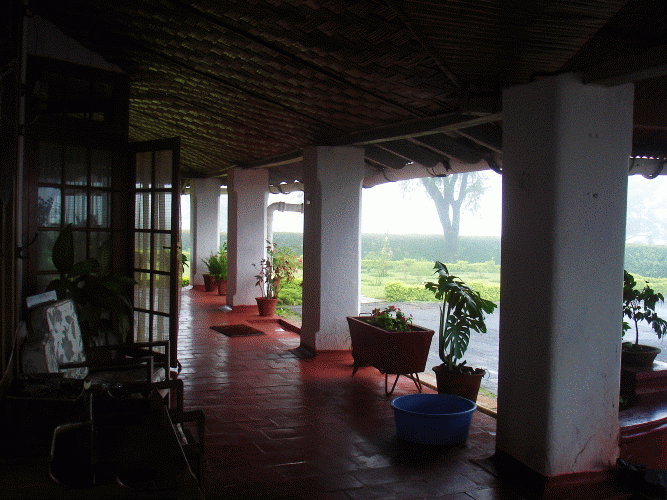
Sunday, August 29, 2010
Mtsnobari
"In the mountains of Georgia, where they graze their flocks of sheep, there exists a special profession-that of mtsnobari, or diviner.
His function is to carry stray lambs back to their mothers in the middle of the enormous flocks.
The mtsnobari infallibly carries each suckling lamb to the right mother, in a flock of hundreds of animals, finding her by means of a particular "sense of smell". He has nothing to help him except the answering voices of ewe and lamb. However, if you take into account the fact that entire flock is bleating, that is clearly not going to simplify things much."
7 February, 1976
Time Within Time - The Diaries 1970-1986
Andrei Tarkovsky
His function is to carry stray lambs back to their mothers in the middle of the enormous flocks.
The mtsnobari infallibly carries each suckling lamb to the right mother, in a flock of hundreds of animals, finding her by means of a particular "sense of smell". He has nothing to help him except the answering voices of ewe and lamb. However, if you take into account the fact that entire flock is bleating, that is clearly not going to simplify things much."
7 February, 1976
Time Within Time - The Diaries 1970-1986
Andrei Tarkovsky
After Years
Today, from a distance, I saw you
walking away, and without a sound
the glittering face of a glacier
slid into the sea. An ancient oak
fell in the Cumberlands, holding only
a handful of leaves, and an old woman
scattering corn to her chickens looked up
for an instant. At the other side
of the galaxy, a star thirty-five times
the size of our own sun exploded
and vanished, leaving a small green spot
on the astronomer's retina
as he stood on the great open dome
of my heart with no one to tell.
Ted Kooser
from Solo: A Journal of Poetry, Premiere Issue, Spring 1996
walking away, and without a sound
the glittering face of a glacier
slid into the sea. An ancient oak
fell in the Cumberlands, holding only
a handful of leaves, and an old woman
scattering corn to her chickens looked up
for an instant. At the other side
of the galaxy, a star thirty-five times
the size of our own sun exploded
and vanished, leaving a small green spot
on the astronomer's retina
as he stood on the great open dome
of my heart with no one to tell.
Ted Kooser
from Solo: A Journal of Poetry, Premiere Issue, Spring 1996
Saturday, August 28, 2010
Enkidu
Long ago, attended a fabulous cello conert by a Swedish musician, Svante Henryson. His album Enkidu speaks of an intriguing Mesopotamian myth, represented in the Epic of Gilgamesh, perhaps the oldest written story.
When Gilgamesh, who is two-thirds god and one-third man, becomes so powerful and arrogant that his own subjects cannot bear him, the goddess Aruru whom they go to for help, creates a double for him, called Enkidu. Enkidu is a hairy man-beast, his more natural, elementary, unpolished side, which balances Gilgamesh's arrogance and acquaints him with his humanness, the side that is weak and vulnerable, but also therefore capable of kindness and tolerance.
"We meet Enkidu first in the Epic of Gilgamesh, and learn that he was created to be Gilgamesh's equal and Soul Brother, so that the young, selfish, brutish and proud king of Uruk could know the meaning of friendship, trust, courage and loyalty to become a wholer being. Enkidu's coming into Gilgamesh's life is announced by the dreams of Ninsun, Gilgamesh´s mother, who states that Enkidu will be "a strong companion, the one who helps a friend in need".
from the site: http://www.gatewaystobabylon.com/gods/lords/lordenkidu.html
Found this story beautifully used as illustration in this book: "If you meet the Buddha on the road, kill him" by Sheldon B.Kopp.
"Every man has his Enkidu, his other half, his hidden self. The more he is out of touch with his double the more a man's life is an empty and unsatisfying burlesque. For one strong man who lives like a brute, there is the double of his own soft helplessness to be met. Without his weak and passive double, his capacity for tenderness and gentle touch is also lost.
For another sort of half-man who meets the world as Mr.Nice Guy, there is the danger of living a life of self-degrading appeasement. In order to become free to assert himself when he needs to, he must first be introduced to the ruthlessly dangerous double of his undiscovered rage."
When Gilgamesh, who is two-thirds god and one-third man, becomes so powerful and arrogant that his own subjects cannot bear him, the goddess Aruru whom they go to for help, creates a double for him, called Enkidu. Enkidu is a hairy man-beast, his more natural, elementary, unpolished side, which balances Gilgamesh's arrogance and acquaints him with his humanness, the side that is weak and vulnerable, but also therefore capable of kindness and tolerance.
"We meet Enkidu first in the Epic of Gilgamesh, and learn that he was created to be Gilgamesh's equal and Soul Brother, so that the young, selfish, brutish and proud king of Uruk could know the meaning of friendship, trust, courage and loyalty to become a wholer being. Enkidu's coming into Gilgamesh's life is announced by the dreams of Ninsun, Gilgamesh´s mother, who states that Enkidu will be "a strong companion, the one who helps a friend in need".
from the site: http://www.gatewaystobabylon.com/gods/lords/lordenkidu.html
Found this story beautifully used as illustration in this book: "If you meet the Buddha on the road, kill him" by Sheldon B.Kopp.
"Every man has his Enkidu, his other half, his hidden self. The more he is out of touch with his double the more a man's life is an empty and unsatisfying burlesque. For one strong man who lives like a brute, there is the double of his own soft helplessness to be met. Without his weak and passive double, his capacity for tenderness and gentle touch is also lost.
For another sort of half-man who meets the world as Mr.Nice Guy, there is the danger of living a life of self-degrading appeasement. In order to become free to assert himself when he needs to, he must first be introduced to the ruthlessly dangerous double of his undiscovered rage."
Liminality
"...The Piraha (of the Brazilian Amazon), Everett reveals, possess “the most complex verbal morphology I am aware of [and] are some of the brightest, pleasantest, most fun-loving people that I know.” Yet they have no numbers of any kind, no terms for quantification (such as all, each, every, most and some), no colour terms and no perfect tense. They appear to have borrowed their pronouns from another language, having previously possessed none. They have no “individual or collective memory of more than two generations past”, no drawing or other art, no fiction and “no creation stories or myths.”
All this, Everett believes, can be explained by a single characteristic: Piraha culture constrains communication to non-abstract subjects which fall within the immediate experience of [the speaker]". What can be discussed, in other words, is what has been seen. When it can no longer be perceived, it ceases, in this realm at least, to exist.
After struggling with one grammatical curiosity, he realised that the Piraha were "talking about liminality – situations in which an item goes in and out of the boundaries of their experience. [Their] excitement at seeing a canoe go around a river bend is hard to describe; they see this almost as travelling into another dimension."
from
" A Life with no Purpose" by George Monbiot
All this, Everett believes, can be explained by a single characteristic: Piraha culture constrains communication to non-abstract subjects which fall within the immediate experience of [the speaker]". What can be discussed, in other words, is what has been seen. When it can no longer be perceived, it ceases, in this realm at least, to exist.
After struggling with one grammatical curiosity, he realised that the Piraha were "talking about liminality – situations in which an item goes in and out of the boundaries of their experience. [Their] excitement at seeing a canoe go around a river bend is hard to describe; they see this almost as travelling into another dimension."
from
" A Life with no Purpose" by George Monbiot
Free
Alexis Zorba: Damn it boss, I like you too much not to say it. You've got everything except one thing: madness! A man needs a little madness, or else...
Basil: Or else?
Alexis Zorba: ...he never dares cut the rope and be free.
Zorba the Greek
Nikos Kazantzakis
Basil: Or else?
Alexis Zorba: ...he never dares cut the rope and be free.
Zorba the Greek
Nikos Kazantzakis
Return
".....The Buddha’s return is a pivotal movement, one of those rare events when the divine penetrates history and transfigures it. Like Moses returning from Mt.Sinai, like Jesus appearing in the crowd at the river Jordan to be baptized by John, a man who has left the world returns to serve it, no longer merely human but charged with transcendent power. As the scriptures record of Moses and Jesus, we can imagine how the Buddha must have shone that bright spring morning in the Himalayan foothills.
Dazzled by the radiance of his personality, it is said, people gathered about him and asked, " Are you a god?"
"No."
"Are you an angel?"
"No."
"What are you then?"
The Buddha smiled and answered simply, " I am awake" - the literal meaning of the word buddha, from the Sanskrit root budh, to wake up. "
from the Introduction to
'The Dhammapada'
Translated with a general introduction by Eknath Eswaran
Dazzled by the radiance of his personality, it is said, people gathered about him and asked, " Are you a god?"
"No."
"Are you an angel?"
"No."
"What are you then?"
The Buddha smiled and answered simply, " I am awake" - the literal meaning of the word buddha, from the Sanskrit root budh, to wake up. "
from the Introduction to
'The Dhammapada'
Translated with a general introduction by Eknath Eswaran
Sureness
"....Anthropologists found that schizophrenia is strongest among those whose ties with the cultural traditions are weakest: drug users, intellectuals, immigrants, students in their first year at college, soldiers recently inducted.
A study of Norwegian-born immigrants in Minnesota showed that over a period of four decades their rate of hospitalization for mental disorders was much higher than those for either non-immigrant Americans or Norwegians in Norway. Isaac Frost found that psychoses often develop among foreign domestic servants in Britain, usually within eighteen months of their arrival.
These psychoses, which are an extreme form of culture shock, emerge among these people because the cultural definition of values which underlies their sanity has been changed. It was not an awareness of 'truth' that was sustaining their sanity, it was their sureness of their cultural directives."
Page 387.
'Lila. An Inquiry into Morals'
Robert M Pirsig
A study of Norwegian-born immigrants in Minnesota showed that over a period of four decades their rate of hospitalization for mental disorders was much higher than those for either non-immigrant Americans or Norwegians in Norway. Isaac Frost found that psychoses often develop among foreign domestic servants in Britain, usually within eighteen months of their arrival.
These psychoses, which are an extreme form of culture shock, emerge among these people because the cultural definition of values which underlies their sanity has been changed. It was not an awareness of 'truth' that was sustaining their sanity, it was their sureness of their cultural directives."
Page 387.
'Lila. An Inquiry into Morals'
Robert M Pirsig
Only to grow...
...Never the murdered finalities of wherewhen and yesno,impotent nongames of wrongright and rightwrong;never to gain or pause,never the soft adventure of undoom,greedy anguishes and cringing ecstasies of inexistence;never to rest and never to have;only to grow..."
Introduction
e.e.cummings
Introduction
e.e.cummings
Walking towards Oneself
On that hot summer afternoon in Delhi, on the way to the airport, you see these men in orange robes walking barefeet by the side of the road. So many of them, one behind the other. You ask the taxi driver what this is about. He says that they are pilgrims who go to the holy city of Rishikesh [in the Himalayas] and walk back all the way to their respective towns and villages, carrying with them the holy Ganges water. Sometimes for weeks together. Barefoot. Some of them have bandages on their feet. But everyone is walking at the same speed, briskly, purposefully.
You watch them all the way. You have always been fascinated by pilgrims. And there are so many such pilgrimages all over the country. People walk barefeet to so many temples. Braving the elements. Every year.
You admire their absolute faith. And not just that - you envy them the knowledge that they have of themselves. For it is only when you push yourself to the limits, when you test yourself that harshly, that you really know what you are capable of. If you can walk barefoot for weeks in the blazing sun, maybe you are tougher than you thought? And that knowledge must surely change the way you handle life and its travails afterwards?
And maybe that is the very purpose of a pilgrimage - to show us our own riches?
Maybe all pilgrimages finally lead to ourselves?
We "educated city people" are unlikely to go on these barefoot pilgrimages. We do try and test ourselves in other ways, that somehow appear so trivial compared to these.
Are we missing something very important? Are we living on the surface of our selves? Do we lack faith, do we lack courage, have we been reduced by comfort?
Oct 29, 2006
You watch them all the way. You have always been fascinated by pilgrims. And there are so many such pilgrimages all over the country. People walk barefeet to so many temples. Braving the elements. Every year.
You admire their absolute faith. And not just that - you envy them the knowledge that they have of themselves. For it is only when you push yourself to the limits, when you test yourself that harshly, that you really know what you are capable of. If you can walk barefoot for weeks in the blazing sun, maybe you are tougher than you thought? And that knowledge must surely change the way you handle life and its travails afterwards?
And maybe that is the very purpose of a pilgrimage - to show us our own riches?
Maybe all pilgrimages finally lead to ourselves?
We "educated city people" are unlikely to go on these barefoot pilgrimages. We do try and test ourselves in other ways, that somehow appear so trivial compared to these.
Are we missing something very important? Are we living on the surface of our selves? Do we lack faith, do we lack courage, have we been reduced by comfort?
Oct 29, 2006
A world without gravity
 "...He returned to the clarinet, whose emotional range, from the riotous to the stately, he had not suspected when he was younger. He found a good teacher, an older gentleman, patient, intuitive and funny.
The man told Henry that the only native talent needed to play music well was joy.
Once, when Henry was labouring on Mozart's clarinet concerto, the teacher interrupted him and said, 'Where's the lightness? You've turned Mozart into a heavy, black ox and you're ploughing a field with him.'
With that, he picked up his own clarinet and produced a burst of music that was so loud, clear and brilliant, a wild storm of gyring notes, that Henry was stunned. It was an aural version of Marc Chagall, with goats, brides, grooms and horses swirling about in a multicoloured sky, a world without gravity.
Then the teacher stopped playing, and the sudden emptiness in the room nearly sucked Henry forward."
Page 20, 'Beatrice and Virgil, a novel' by Yann Martel, Author of 'Life of Pi', Winner of the Man Booker Prize
...............................................................................................
Marc Chagall - http://en.wikipedia.org/wiki/Marc_Chagall
Au dessus de la ville (Above the city) - http://www.art.com/products/p10278035-sa-i853147/marc-chagall-au-dessus-de-la-ville.htm
Image taken from Google Images. Most of his paintings are in there.
Yann Martel: "He collaborated with Omar Daniel, composer-in-residence at the Royal Conservatory of Music in Toronto, on a piece for piano, string quartet and bass. The composition, You Are Where You Are, is based on text written by Martel, which includes parts of cellphone conversations taken from moments in an ordinary day."
Friday, August 27, 2010
Anxiety, curiosity and joy
"Henry had written a novel because there was a hole in him that needed filling, a question that needed answering, a patch of canvas that needed painting - that blend of anxiety, curiosity and joy that is the origin of art - and he had filled that hole, answered the question, splashed colour on the canvas, all done for himself, because he had to.
Then complete strangers told him that his book had filled a hole in them, had answered a question, had brought colour to their lives. The comfort of strangers, be it a smile, a pat on the shoulder or a word of praise, is truly a comfort."
Page 2, 'Beatrice and Virgil, a novel' by Yann Martel, Author of Life of Pi, Winner of the Man Booker Prize
Subscribe to:
Posts (Atom)